
Employee Recognition: How a Simple Shoutout Can Transform Your Company Culture
Employee recognition looks different at every company. At Revelry, it takes the form of a quarterly shoutout award to the person in the company who has received the most shoutouts. I’ve never won (boohoo), but I still love the culture of giving shoutouts. I want to extoll the virtues of shoutouts and the impact they can have, so I sat down with our latest shoutout quarterly award winner, Stu Page, to get his thoughts on the subject.
Q1: What is a shoutout?
Stu: A shoutout is a public announcement, either in Slack or in a meeting, that someone has gone above and beyond, or otherwise generally been excellent.
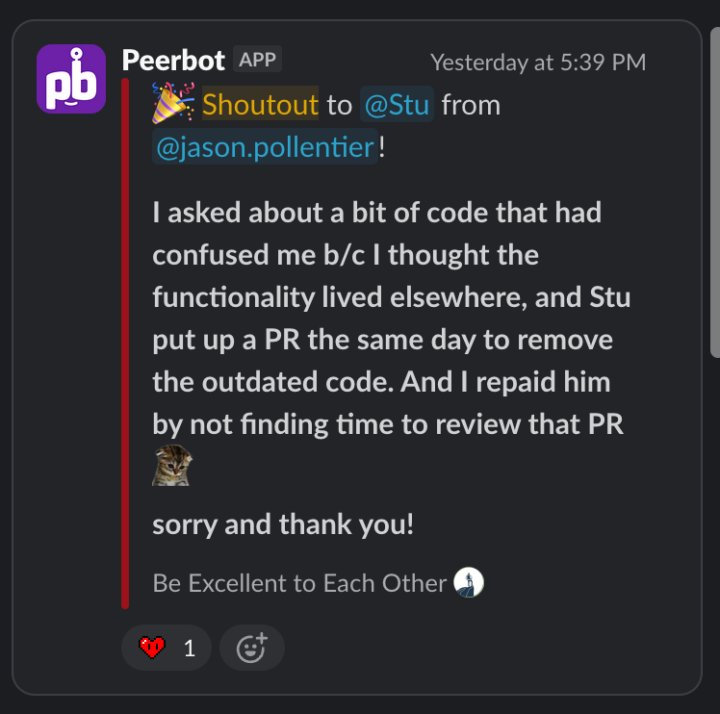
It shows you’re grateful for the people you work with, and that you value their contributions and help to whatever you’re trying to get done.
Q1.5: How do they work, where are they tracked?
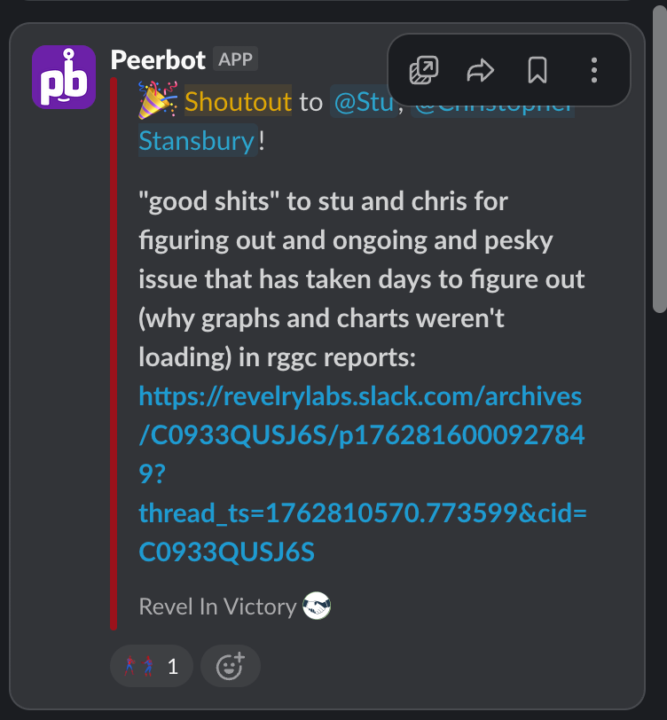
Stu: I think they’re tracked in our custom Slack integration (called Peerbot) and delivered in our central Slack channel, #watercooler. People also do shoutouts directly in the big all hands meeting.
Q2: How do you think shoutouts affect the culture at Revelry?
Stu: I think it’s hugely beneficial. I think there should be more. I think everyone should shout each other out all the time. I’m biased – one of my love languages is words of affirmation – but I think: the more shoutouts, the more people feel grateful, appreciated, and valued, the more the culture is shaped around positivity and helping each other.
Q3: How do you feel when you get a shoutout?
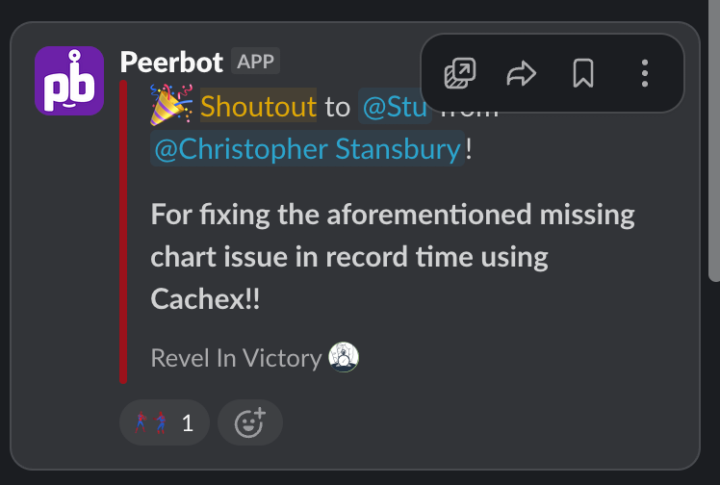
Stu: It feels great! It means “I done good”. What other metric do we have as developers? It’s not lines of code. It’s not outages, honestly. It’s not stats. It’s “do the people you’re working with think you’re doing a good job?”, and they show that through shoutouts.
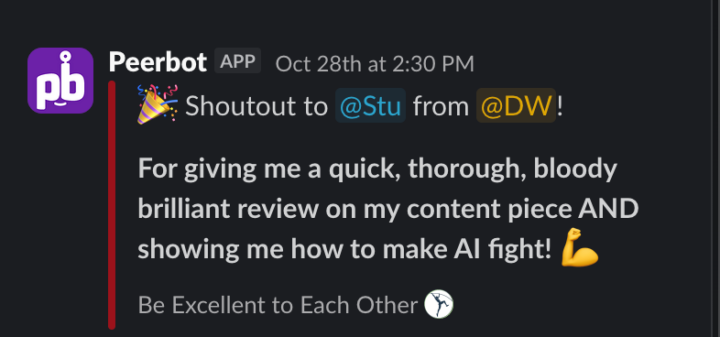
Q4: Why do you think you get so many shoutouts?
Stu: ‘cause the system’s rigged. (Author’s note: this is a joke)
No, I don’t know. I also stand-out without meaning to: I’m British in the US. It’s always nice to have an icebreaker, and I think it’s a reason why I stick in people’s brains.
I also quite like helping people out where I can – in my other life B.C. (Before Computers), I worked with vulnerable populations, and I get a lot of personal fulfillment out of being able to help people.
I also like to give shoutouts to people, and that means I get reciprocal shoutouts back. I’m not expecting them! I’m just trying to share the love!
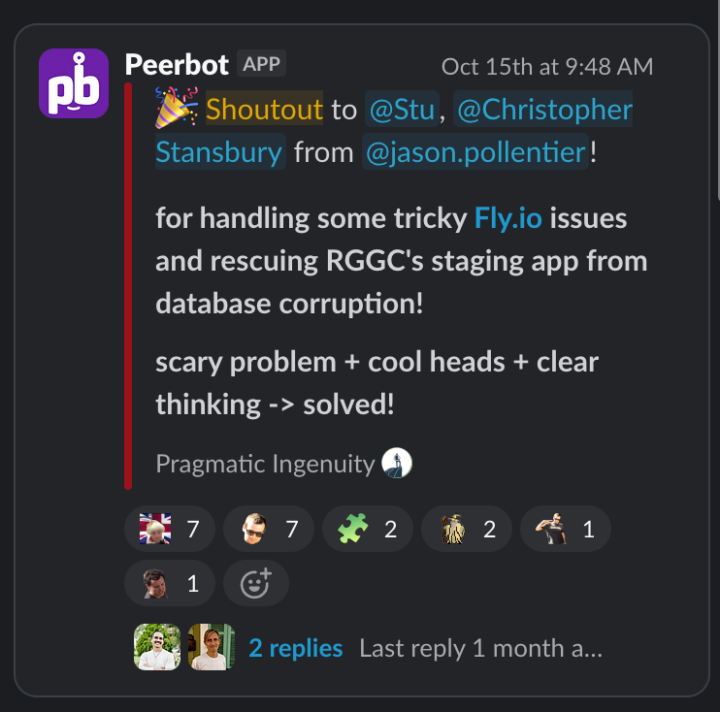
Q5: Do you have a favorite shoutout you’ve ever received?
Stu: The one for getting my thing into elixir radar. That was recent. That felt pretty good. “To his Ukulele playing twin in the rocking chair”, that’s a good one. Oh, my first shoutout I ever got. July 9th, 2021. “Shoutout @stupage for making it to number four in contributions on sun pro, even as an apprentice.” That felt pretty good.
Q5.1: Favorite shoutout you’ve ever given?
Stu: Any shoutout I’ve ever given any apprentice ever. Those are my favorite because they’re the most impactful, because I remember being an apprentice and every shoutout was like “oh my god, someone can see me and thinks I’m doing a good job”.
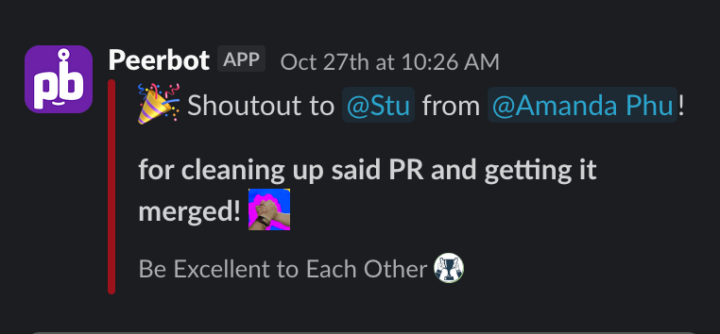
Q6: Do you see any areas of improvement for shoutouts?
Stu: I think people could do more of them. I think there needs to be encouragement to do shoutouts, but I also don’t think they should be mandated. They should be organic because it’s a cultural thing, not a systematic thing, which is what makes it lovely, but also makes it hard. You can’t strategize around good culture, you can only foster it. And that’s a very difficult thing to do. Shoutouts are an example of that and people should do them more, but you can’t tell people to do more shoutouts. When people do more shoutouts, things will be really good, and they’ll also be really good and people will do more shoutouts. It’s cyclical.
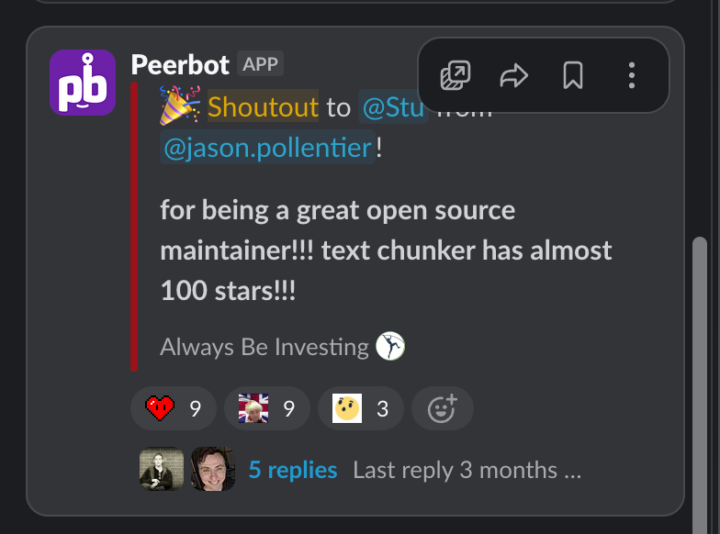
Q7: What advice would you give to a company that wanted to implement a shoutout system?
Stu: Keep a low bar. Don’t make it a super high bar, because people are going to make the bars in their minds anyway. Make them easy to do. Make them visible so everyone can see it. You don’t need to make them anonymous or from someone. You could do either or both, it doesn’t really matter, I don’t think. And then build it in, like we built it into all hands so it sort of works there. Make it easy to do and set a low bar, and I think people want to make other people feel good and show people that they are appreciated.
Shoutout to Stu for sitting down to do this interview and shoutout to you, dear reader, for reading it! I’d like to point out that Stu is being severely modest about his contributions as well as why he gets shoutouts (only 1/6th of all shoutouts he receives are because of his British accent). He’s a tremendously kind and valuable teammate. I’m glad Revelry has shoutouts so that I can readily let him and others know that.
You may be left wondering if I disagree with Stu about any of his answers or about shoutouts in general. I love shoutouts at Revelry, but I think there are some unique ways people can adapt this practice that could lead to wildly different results. For instance, what does a shoutout winner actually win?
At Revelry there is a monetary award that goes with being the overall quarterly shoutout winner. It’s not a problem at Revelry, but when there is a monetary incentive involved, we can see how problems could arise. Employees vying with each other for shoutouts could lead to some problematic “lobbying” behavior so that they can receive the bonus. For example: It’s plausible that someone could leverage passive aggression to guilt people into giving them public shoutouts and boosting their numbers for tasks they wouldn’t have otherwise been shouted out for. This becomes even more hazardous when you couple this idea with managers and direct reports giving each other shoutouts.
I frequently give people who are higher up on the corporate ladder shoutouts because I think a good manager or tech lead is worth their weight in gold (even if it can be misconstrued as brown nosing). However we could see how that might lead to things like favoritism, or on the flip side where you aren’t shouting out your manager, ostracism/criticism. All these personal dynamics might leave some people feeling left out in the cold or downright cynical about the entire practice.
I don’t think it would take much to imagine a situation where the same “favorites” are constantly patting each other on the back, week after week, possibly for something clearing the low bar of doing your job. I think data can be a salve for this, but it can also be a double edged sword. While Stu advocates for a low bar to encourage participation, the risk is that shoutouts become devalued if it’s just for showing up.
If a person in your company never gives shoutouts, why is that? Is it because the bar in their mind is very high? Perhaps a cultural misalignment where they think the practice is a waste of time? Or even most cynically, to keep their numbers higher than the relative average and improve their chances of winning? What about if someone never gets shoutouts? Could it be that they are on a solo project, and so naturally have less of a chance to get shoutouts compared to people on a tight knit team? We can’t know the answers from the data we can glean from records in Slack or the like. They can only drive conversations.
My overall point is that while I agree with nearly everything Stu said and it works well in practice, it works well at Revelry because Revelry already has a really good culture. Adding shoutouts to your employee recognition program may not fix things and may make them worse. We have to be intentional about what we do with our company culture, and we need to tend and foster our processes and rituals like a gardener tending to their garden.
There are places to adapt and experiment with this whole idea. What if shoutouts were mandatory? Everybody picks one person each week, and shouts them out. What if shoutouts acted as a sort of currency where you could only give them by getting them? What if they had to be anonymous? What if multiple people had to coordinate shoutouts before they were logged?
I agree with Stu that shoutouts have the ability to make us feel seen and appreciated, and that it’s a good way of telling someone you work with that you value them, but there’s a lot more nuance in the implementation that makes it work for us, and I would be curious to hear about cases where shoutouts have not worked out, and how those systems were implemented.
Do a little experiment today. Give someone a shoutout, and see how it makes you both feel.