AI Adoption and Product Management: Proven Across Industries
I'm a product manager who spends most of my day inside an AI product I help build. Let me rewind to before AI was part of everyday life.
We're coming up on the six-year mark of a pandemic that erased nearly 27 million American jobs in just two months. Entire industries went dark overnight. People lost work, lost stability, lost their sense of what was next. Including me. I went from being a product manager to cooking for friends. One gathering turned into a full spread, a friend asked if I'd meal prep for her, and I said yes. That yes turned into a business.
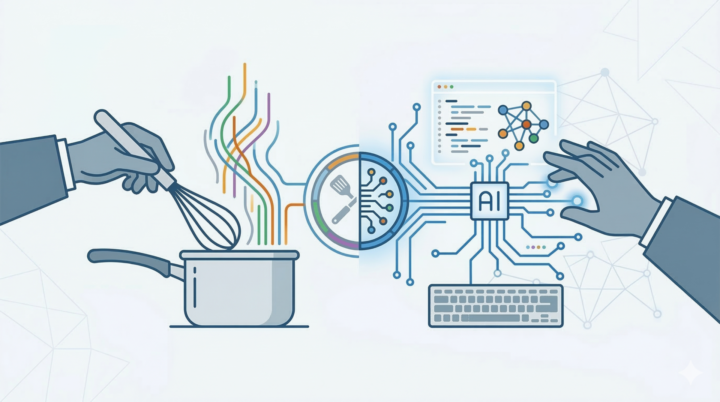
That was NOLA Phud. I translated my product management skills into building and running a business: discovery, sprints, iteration. But AI didn't exist yet, so I was learning and doing all of the work by hand. You don't need to be in tech to think like a product manager, and real AI adoption starts with the work you don't even realize could be done differently. This is that story.
Here's what you need to know about the timing: ChatGPT did not exist in 2020. GPT-3 launched in June of that year, but it was API-only, available to developers and researchers. The average person had no idea it existed. The wave of AI adoption that changed everything? That started in November 2022, more than two years after I was spending my Sundays elbow-deep in meal prep.
Everything I'm about to describe, I did by hand. Looking back, I wish I had AI then. The research, the math, the logistics, all of that is exactly the kind of work AI handles now.
Before AI: The Manual Grind
The first week was just a handful of orders from close friends. My early adopters. I wasn't doing boring chicken-rice-broccoli. I wanted healthy gourmet meal prep that hit the right macros and actually tasted good. By week two, word was spreading and adoption was growing. I was building a website on Wix to keep up with interest.
Research and discovery were constant. I was testing new recipes, paying attention to what customers reordered and what they skipped, adjusting menus based on feedback. Every week I was learning what worked and what didn't, the same way you'd run discovery on any product.
Every week was a one-week sprint. Tuesdays I’d kick off with a new menu on Instagram. Orders came in through Friday, and I’d spend the week engaging with customers, answering questions, building anticipation. By Wednesday I was already planning next week’s menu, deciding what to offer, what to change, what to try. Those were my user stories. Thursdays and Fridays I’d be scoping requirements and estimating for the current sprint: tallying orders in Excel, plugging in base recipes, doing the math to scale each one.
Individual serving sizes multiplied by however many orders came in. At the same time, I’d manually enter next week’s recipes into MyFitnessPal to calculate macros and make sure every dish hit the right nutritional targets. Those were my acceptance criteria. The nutrition info I’d post alongside each menu was the spec.
Then resource allocation. I learned fast which vendors were better for what. Restaurant Depot for proteins in bulk. Costco and Sam’s for staples. I’d divide my grocery list across them, trying to stay within budget while maintaining quality. Friday or Saturday was shopping day.
And then Sunday was build day. Twelve to sixteen hours. Nonstop. Cooking, prepping, packaging. Every container had to look as good as it tasted. Mondays, I’d deploy: clients would come pick up their orders from my house.
The domain was food, but I ran it the way I'd run any product. Planning, scoping, building, shipping, getting feedback, iterating. Every single week. That's product management. The customer picks up a meal on Monday and sees the finished product. They don't see the discovery, the scoping, the resource planning, or the iteration that made it possible. Most people only see the delivery. The work that makes it worth delivering happens everywhere else.
All of it was manual. All of it was me.
And I didn't know how to run a business. I was Googling everything. Food safety requirements, pricing strategy, how to calculate food costs, how to set up an LLC. Piecing it together one search at a time, pulling answers from ten different tabs into something I could act on. Today, AI could aggregate all of that into a single conversation. One place to ask every question, get context-specific answers, and build a real plan instead of spending hours just figuring out what to search for next.
Over the life of the business, I served over 100 customers and was averaging around 200 meals a week at peak. I started in July 2020, ran it full time until I joined Revelry in April 2021, and I still cook personally today. When I started using our AI platform for my own recipes, that's when it hit me: this is what I needed back then.
What I Didn't Know
Looking back now, I can see exactly where AI adoption would have changed everything. Not replaced me. I still would have been the one cooking, tasting, deciding what made the menu. But the hours I spent on math? On scaling recipes from 4 servings to 40? On manually entering ingredients into MyFitnessPal one at a time? On figuring out which store had the best price on which ingredient? AI could have handled all of that.
Outside of work, I use our AI platform for exactly that kind of thing. I have a prompt that compares multiple versions of the same recipe, analyzes their strengths, and builds an optimized version that pulls the best elements from each. I have one that takes my recipes, combines similar ingredients across dishes, converts everything to US units, and organizes it all into a grocery list by department so I can move through the store in one pass. I even have one that builds a cooking timeline when I'm prepping multiple recipes at once, figuring out how to use equipment in parallel so I'm not standing around waiting while something roasts.
The same manual grind I lived through with NOLA Phud, compressed into minutes.
When most people think about AI, they think about the surface. Trendy image generators. Novelty chat conversations. Viral content. That's not where the power is. The power is in the boring stuff. The work that eats your time and nobody wants to talk about. The Excel math. The grocery list optimization. The pricing calculations you run over and over. That's the work AI was built for. And that's the kind of work our team is focused on: building AI tools that help real businesses solve the same problems I was solving by hand.
But AI adoption isn't limited to cooking or product management. Our entire development team uses AI every day, and I see the same pattern with every business our team works with.
A construction company where project managers were spending two to three hours a week manually compiling reports from Procore. Now an AI pipeline pulls the data, generates structured reports, and lets them refine from there. A private equity firm that was falling two quarters behind on financial collection because the entire process ran on manual emails. Now it's automated end to end. A bakery where the team is using AI for the same thing I was doing by hand with NOLA Phud: ingredient cost calculations, pricing analysis, figuring out the math behind the menu.
Different industries. Different problems. Same pattern. Manual work that eats hours, and AI that gives them back.
I didn't know what I didn't know. And when it comes to AI adoption, I think that's true for a lot of people right now, in every industry. You're doing work the hard way. You just haven't seen what's possible yet. I know because I was one of those people.
The Bridge
I joined Revelry in April 2021. For the first couple of years, I worked on several different partner projects, none of them AI-related. I was doing what I'd always done: managing products, running sprints, shipping software.
Then in late 2023, everything shifted. Our team had been building an AI product since that summer, starting as a proof of concept to generate user stories in a terminal application and evolving through experiments with RAG and retrieval. By the time I joined the project in December, it had already grown from that terminal proof of concept into an MVP.
That was my first real step into AI adoption.
The product was early, but it wasn't simple. It already had data source integrations, retrieval capabilities, and a prompt library with structured workflows. It didn't have chat yet, and it didn't have agents. But the foundation was technically deep. And pretty quickly, our team got reduced. Budget was tight, runway was short, and we went from a full team to just me and our CEO. I was doing everything. Not just product and demos, but sales, marketing, and go-to-market. None of which I had any background in.
So I used our own tool to figure them out.
I didn't know how to do sales outreach. I didn't know how to write marketing copy or engage on LinkedIn in a way that actually drove interest. But I had an AI platform sitting right in front of me. So I built prompts. First for user stories, because that's what I knew. Then for research. Then for meeting notes. Then for the sales and marketing work I was learning on the fly. Each prompt was another task I didn't have to figure out from scratch.
And that's when something clicked. I was building prompt after prompt, and the process felt repetitive. Defining the role. Defining the task. Defining the output format. The same structure, over and over. So I thought: can I get this to help me build the prompts themselves?
I didn't know it had a name. I just started googling and realized that what I'd stumbled into was called meta prompting. A concept that already existed. I'd discovered it on my own, the same way I'd discovered everything else: by doing the work and hitting the wall and finding a way through.
That's the pattern. With NOLA Phud, I didn't know how AI adoption could have helped me. With our AI product, I didn't know meta prompting was a thing until I'd already been doing it. I keep learning what I didn't know, after the fact. And every time, it changes how I work.
It's Not About Replacement
One of my coworkers, Laura, our VP of Design, put it in a way that stuck with me. She doesn't want AI to do the creative work for her. That wasn't the point of AI adoption. She asked herself: what is it that I don't enjoy having to do? That's where she points AI. Not at the craft. At the friction around it.
That framing changed how I think about it. When I was running NOLA Phud, I loved the cooking. I loved the creativity, the R&D, the plating, the customer relationships. What I didn't love was the three hours of Excel math every Thursday night. AI wouldn't have taken away what made the business mine. It would have given me back the time I was spending on the parts that drained me.
When it was just me and our CEO trying to sell an early-stage product, I wasn't a salesperson. I wasn't a marketer. But AI didn't need me to be. It helped me do the work I didn't have experience in, so I could focus on the work I did: building the product.
And at Revelry, I apply the same lens to my day-to-day as a product manager. What's manual that shouldn't be? What am I spending time on that AI can handle so I can focus on the work that actually needs me? The answers keep surprising me.
My AI adoption story didn't end there. I ended up inside the product our team was building. Using it every day. More than anyone else. Breaking it, building workarounds, and watching those workarounds become features.
That's a different kind of story. I'll tell it in Part 2: Dogfooding as a PM: The Power of Building From the Inside.